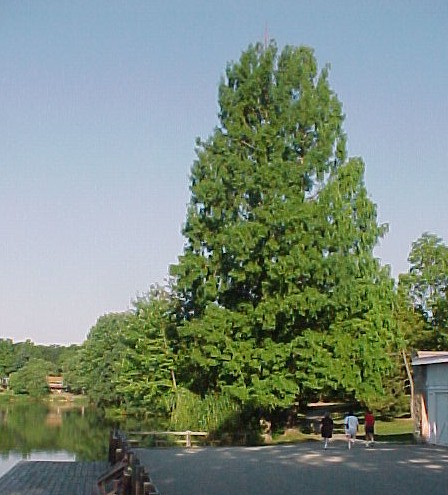
Dawn Redwood Information links
Mirror sites are included below these links.Many sites have evaporated, some due to the vulnerability of closed source servers.
Unfortunately some valuable information has been lost.
It is hoped that some of the remaining information can be preserved here using open source software.
Any complaints from the original owners will result in immediate removal of content and links from this site!
Jasons favorite is the Dawn Redwood
U of Connecticut Plant data base
Companion for Rhododendron& Azaleas
Information
clips and mirrors of other sites that have long since dissappeared
UNAUTHORISED MIRROR OF:
http://waynesword.palomar.edu/ww0803.htm#dawn
4. The Dawn Redwood:
Another ancient cone-bearing tree that was thought to be extinct but was later discovered growing in a remote valley of Central China is the dawn redwood (Metasequoia glyptostroboides). The genus Metasequoia was first described from fossil material by the Japanese paleobotanist Shigeru Miki in 1941. In 1948, paleobotanist Dr. Ralph Chaney of the University of California, Berkeley led a 10,000 mile expedition up the Yangtze River and across three mountain ranges to a lush, fog-shrouded valley where a thousand dawn redwoods were growing. Leaf imprints and petrified wood of ancestral dawn redwoods resembling the present-day species have been found in Cretaceous deposits throughout North America. Some of the fossils date back nearly 90 million years, from a time when the climate was much more humid than today. It has been estimated that the relict forest in China may have been surviving in this remote primeval valley for countless thousands of years. The seed cones and foliage of the dawn redwood superficially resemble our California coast redwood (Sequoia sempervirens), except that the dawn redwood is deciduous and loses its leaves during the winter months. All North American plantings of this superb cone-bearing tree came from the seeds (and their progeny) originally collected in China. Indeed this "living fossil" was brought back to its ancestral home.

| The foliage and cones of the dawn redwood (Metasequoia glyptostroboides) superficially resemble the California coast redwood (Sequoia sempervirens). This lovely deciduous conifer once coexisted with dinosaurs in North America during the Cretaceous Period 90 million years ago. |

| A 25 million-year-old leaf of dawn redwood (Metasequoia) from the John Day Fossil Beds National Monument in Eastern Oregon. Close examination of the needles reveals that this extinct species is not a Sequoia, but is remarkably similar to our present-day Metasequoia. The soft brown shale is from ancient Miocene lake bed sediments made from layers of volcanic ash and silt. Many conifers and broad-leaf angiosperms have been identified from this fossil-rich shale (note other leaves in photo). |
Ancient Plant References
|
UNAUTHORISED MIRROR OF:
http://www.dinosauria.com/jdp/misc/conifer.htm
-
Conifer growth
Jason Ashley
The growth pattern of conifers in general follow the same pattern of growth as found in broadleafed though there is the tendency to the conical form. What effects the growth pattern more than anything though is the proximity of other trees and available light. Assuming that wind is not a factor (as with isolated bristlecones), one can expect the tree to spend most of its energy as a juvenile growing toward the light source as quickly as possible. This means that in a dense wood the tree would sacrifice branch growth in favor of trunk growth until it reaches an acceptable light source when it would then begin to branch more laterally. To say that any one of these trees has a "pure form" would be incorrect as the tree will take advantage of its situation either as a single, isolated plant or as part of a dense wood.
Today we can see ornamental, non-hybridized conifers planted in isolation and given proper care will have a tendency to the conical (Christmas tree) form but this situation is uncharacteristic of their growth in the wild. The simple reason why lower branches are not present in most wild specimens is simply because there is not enough light at lower levels to warrant spending the energy to grow branches beneath the canopy level. Same is true in a rain forest. Trees which are singular (not in a stand) will not grow as tall as trees in a stand because there is no need to expend the energy to out-compete the smaller undergrowth or the rest of the woods in general. Fourth level forests (the most mature stage of forest growth) comprise trees of all kinds that sacrifice lateral for vertical growth.
The "ancient" trees we have left today are few, but telling. The umbrella pine, dawn redwood, and larch are all strongly conical when left in isolation from competition and truly they have very rigid forms but they are not known to have ever developed in the wild this way. ... What each of these plants has most in common is the ability to throw sports of leaves along the trunk. In the days of the dinosaurs these trees were most likely only going to survive by growing as tall as possible and producing as few branches and leaves as possible until they reached above the reach of dinos looking for a tasty meal.
The umbrella pine grows excruciatingly slowly (6" in a good year) while the dawn redwood can grow exceedingly fast (6' in a good year). If speed is a factor in survival then why the big difference? The theory is simply that umbrella pines were not favored food and in any event are not known to grow very tall (80') today though they are exceedingly dense in needles. They, like the laughable monkey puzzle, probably used their needles as a defense to make them less palatable. Dawn redwoods had to use speed because the soft fronds are very palatable to animals even today so the effort to redirect energy into growing above edible level was an immediate need. What the dawn redwood does do, besides growing so fast, is to grow its lower branches higher than edible level as a form of defense. Lower branches of dawn redwoods grow "up" along the underside of the tree and once they have reached beyond the width of the tree leaf profusely. Leaves in the inner part die though there are always (this is important) sports along the trunk defended by dense branches with no leaves on them until the end of the tree. That's why dawn redwoods look like other conifers in that there are no leaves on the interior. But in the dawn redwood you get the sports on the trunk. So what's going on is the tree has prepared a "last defense". In case all the outer leaf bracts are eaten the tree still has leaves which are unreachable to all but the most determined predator. Left alone and totally de-leafed the tree still has a chance to gain photosynthesis from the sports along the trunk while it concentrates on re-leafing itself and growing taller. This kind of event is naturally disastrous to the tree but it works. Larches work the same way.
...
Dawn redwoods were found only so recently (1945) and then only from a small stand of trees which averaged about 60' and they were not densely packed together in a forest setting. The stand was isolated and on a mountain which could further explain the apparent slow-growth of the trees and the dwarfed stature of them. Soil was also poor and dry. This combination of factors may have caused their reason for survival, stunting growth and retarding aging. Today's oldest dawn redwoods grown from that stand are cultivated as specimens isolated from each other and thus we aren't able to judge how they would act in the wild (largest one I know of is now 160'). We would need a trial stand grown as a laboratory forest in order to determine how they would act in the wild left to their own devices. That might not be too much help either given that we do not know what kind of element they would have prospered in except that we do know they favor wet, loamy soils with a fairly shallow water table (6'-12'). Would there have been other plants growing nearby that formed a symbiotic relationship necessary for mutual survival? Certain organisms, insects, something we don't know? It's hard to say.
I've loved each of these trees and have grown and watched them with morbid curiosity since I planted them when I was 11 (my parents thought I was crazy asking for a tree for a birthday present), 12 (even more nuts), and 15 (certifiable), but I was lucky to live on a very large parcel of land and I thought, 'If I can't have dinosaurs, I could at least have their trees!'. A monkey puzzle will not live as far north as where I am, sad to say. The dawn redwood is my favorite because it is so genuinely beautiful. The fronds are airy and bright green while the wood is dark red. In autumn it is bronze and there is nothing like it. Pick one up! They grown fast near a stream and once the roots reach the water, POW! you get up to 6' a year. The deer will eat it but it defends itself and has faced more far, far, more dangerous predators...........
Copyright © 1996 by Jason Ashley.
This article was a public post to the Dinosaur Mailing List.
Revised October 28, 1996
UNAUTHORISED MIRROR OF:
http://www.ext.vt.edu/departments/envirohort/factsheets/trees/daredwd.html
Dawn Redwood
(Metasequoia glyptostroboides)
Contact: Diane Relf, Extension Specialist, Environmental HorticultureAugust 1996

- Summary:
-
Foliage: Deciduous needles
Height: 70 to 100 feet
Spread: 25 feet
Shape: UprightBright green, feathery, needle-like foliage turns brown and drops quickly in the fall. One of the few deciduous conifers.
- Plant Needs:
-
Zone: 6 to 8
Light: Partial shade to full sun
Moisture: Moist to dry
Soil Type: Sandy, loam, or clay
pH Range: 3.7 to 7.0 - Functions:
-
Suggested uses for this plant include summer screen and specimen plant.
- Planting Notes:
-
Transplants readily.
Grows best in deep, moist, well-drained, slightly acid soil.
Plant in full sun. - Care:
-
Easy to maintain.
Pruning is usually not needed because of the plant's neat, pyramidal growth habit. - Problems:
-
No serious pests.
- Alternatives:
-
Consult local sources, including historic or public gardens and arboreta, regarding cultivars and related species that grow well in your area.
Cultivars of METASEQUOIA GLYPTOSTROBOIDES:
No important cultivars. - Comments:
-
Known only as a fossil from prehistoric times, Dawn Redwood was discovered in 1945 growing in a remote valley of Central China.
Seeds were brought to the United States in 1948 and distributed throughout the country. - Additional Materials:
-
The following Extension publications are available through your local Extension office or directly from: Virginia Tech Extension Distribution Center 112 Landsdowne St. Blacksburg, VA 24061
#426-500 "Winter Injury to Trees and Shrubs"
#426-604 "Selecting Landscape Plants - Rare and Unusual Trees"
This material was developed by Carol Ness as part of the Interactive Design and Development Project funded by the Kellogg Foundation. Mary Miller, Project Director. Diane Relf, Content Specialist, Horticulture. Copyright 1989 by VCE.
UNAUTHORISED MIRROR OF:
http://www.dawnredwood.com
~ empty ~
The original site has evaporated...
UNAUTHORISED MIRROR OF:
http://www.dawnredwood.org
The Crescent Ridge Dawn Redwoods Preserve
Somewhere in the Sauraton Mountains of North Carolina, lies the Crescent Ridge Dawn Redwoods Preserve: a private endeavor to re-establish a self regulating forest of metasequoia in the Appalachian region. Here, among 50 acres of misty hills and hollows, dawn redwoods flourish in an environment strikingly similar to the Sichuan and Hubei provinces of China. Located some five to six hundred miles further to the north, but at a lower altitude, C.R.D.R.P. provides a virtually identical climate to the Chinese forests in the Shui-sa Valley that Metasequoia has called home for the past several million years. In China, dawn redwoods grow amidst oak, sweetgum, sassafras, hemlock, chestnut, and Katsura trees.
At the NC site, hemlock is replaced by Virginia pine, and the Katsura by its American counterpart: redbud. The remaining aforementioned species also live here, with the exception of the now nearly-extinct American chestnut. In addition tulip, hickory, dogwood, elm, ironwood, sourwood, maple, cherry, and beech constitute the hardwood forest of the area. The local pioneer species is Virginia pine, which covered about two thirds of the property when the project was created in 1995. Most of the pines will eventually be replaced with metasequoia as well as some ponderosa pine, incense cedar, western red cedar, and some other large growing conifers such as sugar pine, Cryptomeria japonica, etc. Coastal redwood is being planted in some steep, moist, well drained areas with favorable results. Swampy and pond areas are planted with baldcypress and metasequoia. Since part of the project revolves around research and experimentation, dawn redwoods have been planted in every conceivable location, including standing water. One has yet to drown, lending credence to the Chinese name of shui sa (water fir). Metasequoias are known to attain heights approaching 200 feet. Since data is constantly changing, C.R.D.R.P. will offer botanists a chance to study growth habits here in the U.S. It is a distinct possibility that the big trees in China have not reached their full potential in size or age. Perhaps, in the next millennium, the Preserve will have trees that rival Coast redwoods.
Crescent Ridge was founded in 1995 by Doug Hanks, who is responsible for most of the progress, and acts as chief conservation officer for the project. "It's hard work," he admits, "but it will be worth it. I have dedicated the rest of my life to this project. One day, people will be able to come here and see what a metasequoia forest looked like 50 million years ago. What a sight that will be. Such a forest has not flourished in North America for tens of millions of years; possibly since the last of the saber-tooth tigers vanished into history." At the age of 27, he planted the first tree of what will become the only redwood forest in the eastern U.S., and the sole wild dawn redwood forest outside of China.
The Preserve is tentatively scheduled to open to the public in 2035. Visitors will be able to wander pathways through groves of dawn redwoods. The project's goal is 5000+ metasequoias, plus the other large species mentioned earlier. "I have laid the preserve out like the national parks out west," Doug says. "Just on a smaller scale. We will simulate old growth characteristics, such as a planted 'fairy ring', to serve as a natural pulpit for wedding ceremonies. People will walk on pathways created before the trees were planted, giving the effect of ancient Indian trails. The trails will open into pure groves of dawn redwoods with mixed forest in between. We would also like to design one or two hilltop overlooks with views of the surrounding mountains." C.R.D.R.P. will also offer a Visitor's Center, with films and interpretive exhibits, including many fossils of Metasequoia, silicified cones, and petrified wood. It will also feature anything "metasequoia related", such as stamps, articles, photographs, etc.
As the project progresses, more information will become available. C.R.D.R.P. will eventually create its own website, with pictures and further information. For now, we are grateful to metasequoia.org for its generous offer to share its webspace.
The location of the Preserve must remain vague, at least for now, for obvious reasons. If people knew there were redwoods in the vicinity, they might search for giant trees, possibly trampling seedlings in their quest. Vandalism would also be likely to occur. So for now, the exact location of Crescent Ridge Dawn Redwoods Preserve must remain a secret, except to a few individuals in related fields. People who are genuinely interested in the project may contact Special Ranger Doug Hanks at the following e-mail address: Dawnredwoods@cs.com.
We at Crescent Ridge Dawn Redwoods Preserve hope you have found this information interesting, and will come to visit when we open.
UNAUTHORISED MIRROR OF:
http://www.metasequoia.org
Welcome to Metasequoia.org
The Nonprofit Chinese Plants and Natural History Consulting Organization
We are providing information to those of who are interested in the Chinese Plants, the Natural History and the Chinese Culture, with all related resources you need from that ancient orient country - China!
Request for Cultivated Information of Metasequoia glyptostroboides in your local area, either a country, state or garden/arboretum sightings. Records can pertain to either a single tree or numerous individuals on a plantation. Please email me at jinshuangma@bbg.org with it's size, height, Diameter at Breast Height, date of cultivation, as well as detailed locality data - Information will be combined into final report of a worldwide survey currently being conducted, and will be recorded on the natural history of Metasequoia glyptostroboides - Thank you very much for your help!

Where does Metasequoia come from? - China, "Mother of Gardens"!
Who said this? - Western plant collectors on the Chinese Plants: E. Breschneider, E. H. M. Cox, G. Forrest, R. Fortune, A. Henry, F. Kingdow Ward, R. Lancaster, L. A. Lauener, J. Rock, E. H. Wilson - "Chinese" Wilson ! ...
How was Metasequoia found? - The Mystery since 1941 ...
Fossil - Shigeru Miki (1941), First Specimen - Wang Zhan (1943), The Type - Hseuh Chi-Ju (1946), First Report in China - Hu Hsen-Hsu (1946), First Report in USA - Chaney, Ralph. W. (1947), The Living species described - Cheng Wan-Jun and Hsen-Hsu, Hu (1948), ... On the unsolved mystery of Metasequoia (2003), The Chronology of The "Living Fossil" Metasequoia glyptostroboides (Taxodiaceae) - A Review (1943-2003) - English,Chinese, Spanish, French, Germany ....
Selected links related to Metasequoia and Plant Taxonomy
Metasequoia: Publications and Websites; Plant Taxonomy: Floras, Society/Association, Database, Herbaria, Arboretum/Gardens, Website ...
How to travel to the Hometown of Metasequoia?
It's very easy today, no matter where you are from, by Airplane, Boat or Bus/Car ...
Acknowledgment
The interesting story from our reader who visited the Hometown: The Emails from our readers.This website was founded by the Metasequoia's and Professor Wang Zhan's students, 2000:
Dr. JinShuang Ma, Research Taxonomist, Brooklyn Botanic Garden, Brooklyn, NY 11225-1099, USA; Dr. GuoFan Shao, Associate Professor, Purdue University, West Lafayette, IN 47907-1159, USA; Dr. Hong Qian, Associate Curator of Botany, Illinois State Museum, Springfield, IL 62703, USA; Dr. JiQuan Chen, Associate Professor, University of Toledo, Toledo, OH 43606-3390, USA - ALL COPY RIGHT RESERVED!Email us your comments/suggestions: jinshuangma@bbg.org
Initiated March, 1, 2000; Last Updated May 4, 2004
UNAUTHORISED MIRROR OF:
http://www.bcc.orst.edu/hort226/megl.htm
empty
The original site has evaporated...
UNAUTHORISED MIRROR OF:
http://www.newton.dep.anl.gov/natbltn/200-299/nb247.htm
Forest Preserve District of Cook County (Illinois)
Nature Bulletin No. 247-A   December 3, 1966
Forest Preserve District of Cook
Seymour Simon, President
Roland F. Eisenbeis, Supt. of Conservation

****:THE GINKGO AND THE DAWN REDWOOD

For a mile or more along each side of Harlem Avenue, one of the main
thoroughfares on the west side of Chicago, there is a row of small
graceful trees which were planted there as seedlings about twenty years
ago. At this season their leaves have fallen and they appear much the
same as other trees in winter. But looks are deceiving because this is the
Ginkgo, or Maidenhair Tree, and one of the strangest trees in the world
-- a living fossil.

Until their seeds were brought to Europe and this country, this tree had
been known only in the sacred groves around temples in China and
Japan. All of its wild ancestors seem to have disappeared. We know
that back in the age of dinosaurs there were many kinds of maidenhair
trees because, throughout the northern hemisphere, we find their
curious fan-shaped leaves in the same layers of rock as the fossils of
those reptiles. Of all that large group, the ginkgo remains as the only
tree of its sort living in the world today, and the fossil record shows that
it has survived, unchanged, for at least a hundred million years.

The ginkgo is not a fern, nor a pine, nor a hardwood tree, but a
combination of the features of all three. Its small yellowish plum-like
fruit has a foul-smelling pulp enclosing a silvery nut with a sweetish
resinous edible kernel. The fruit and the pollen-bearing catkins are
borne on separate trees. The ginkgo has smooth light-gray bark and
attains a height of 60 to 80 feet. Because it is hardy and remarkably free
from pests, it has become increasingly popular for shade-tree planting
on city streets and in parks.

Only a few years ago, another "living fossil" was discovered in a remote
bandit-infested mountain valley of Central China. It has been named the
Metasequoia, or Dawn Redwood, because it appears to be the ancestor
of the Redwood and the Big Tree, or Giant Sequoia, of California. It
was supposed to have become extinct many millions of years ago, but,
from fossil remains of its leaves, twigs and cones found in rocks often
100 million years old, it was known to have been widespread over the
temperate regions of the northern hemisphere.

The discovery, in 1944, of a living dawn redwood -- 64 inches in
diameter and 98 feet tall -- towering above a small temple in the midst
of rice paddies more than 100 miles northeast of Chungking in
Szechwan Province, reads like a fiction thriller. Many people if
different races and classes played a part in this most outstanding
botanical discovery of the century. In March, 1948, Dr. Ralph W.
Chaney, a specialist on fossil plants at the University of California, flew
with a companion to Chungking. From there they traveled by boat down
the Yangtse River, and then inland over rocky trails under the
protection of armed guards to see this tree. Later, they found small
groves of dawn redwoods growing in sheltered mountain ravines in
company with birches, chestnuts, sweet gums, beeches and oaks -- the
same hardwoods we have here in our country.

The most surprising feature of the dawn redwood is that, unlike the
evergreen sequoias, it sheds its leaves in autumn. Further, its cones are
borne on long naked stems and the leaves are arranged in opposite pairs
on the twigs instead of alternately. Their branches slant upward instead
of growing horizontally and turning down at the tips, as do those of the
sequoias. Its seeds are small wafer-like discs similar to a flake of rolled
oats. Some of these seeds were brought back, have been planted, and
young dawn redwoods are growing in several places in the United
States, including Cook County.
UNAUTHORISED MIRROR OF:
http://www.oardc.ohio-state.edu/www/reports/orep9907.html
'A Celebration of Trees': Where to Go to See a 'Living Fossil'
 You
might be familiar with the dawn redwood tree. It's a fast-growing,
pyramidal conifer that drops its needle-like leaves in fall. But what
you might not know
is that until 1941, the dawn redwood was known only from fossils; no
one had ever seen one
before. In that year, a Chinese forester discovered a lone dawn redwood
in a remote
mountain village in China. In 1948, a Harvard scientist distributed
seeds from this tree
to botanical gardens in Europe and North America. One of these gardens
was OARDC's Secrest
Arboretum, where more than 30 dawn redwoods are still growing today.
The dawn redwood has
quite a history -- it was common 100 million years ago! -- and you can
learn more about it
at the Wooster Garden Festival, July 16-17. Guided van tours will take
you to dawn
redwoods in the arboretum, on the College of Wooster campus and
elsewhere in Wooster. The
theme: "A Celebration of Trees!"
You
might be familiar with the dawn redwood tree. It's a fast-growing,
pyramidal conifer that drops its needle-like leaves in fall. But what
you might not know
is that until 1941, the dawn redwood was known only from fossils; no
one had ever seen one
before. In that year, a Chinese forester discovered a lone dawn redwood
in a remote
mountain village in China. In 1948, a Harvard scientist distributed
seeds from this tree
to botanical gardens in Europe and North America. One of these gardens
was OARDC's Secrest
Arboretum, where more than 30 dawn redwoods are still growing today.
The dawn redwood has
quite a history -- it was common 100 million years ago! -- and you can
learn more about it
at the Wooster Garden Festival, July 16-17. Guided van tours will take
you to dawn
redwoods in the arboretum, on the College of Wooster campus and
elsewhere in Wooster. The
theme: "A Celebration of Trees!"
UNAUTHORISED MIRROR OF:
http://www.ccia.com/~tlryan/pbs_9904.htm
Bonsai Care Sheet
| Species: | Common name: | Dawn redwood |
| Botanical name: | Metasequoia glyptostroboides | |
| Japanese name: | Not available | |
| Yoshimura reference: | not listed |
Advantages: Ease of acquisition; fast grower; deciduous conifer; hardy; cuts back well; good buttress when relativity young; wires well; delightful foliage; excellent fall color; a good substitute for the California redwood.
Disadvantages: I can't think of many except people don't try it. It is a strident upright grower but could serve well in other forms.
Bonsai Potential: 9 on a scale of 1-10
Growing location: Treat as a bald cypress: full sun, thorough watering.
Watering: Grow in well drained soil but water thoroughly.
Propagation: Seed, cuttings: buying a sawn redwood would be best.
Fertilizing: Balanced May to October every week or two.
Over-wintering: Hardy as a stone; however, it cannot be allowed to dry out. Mulch heavily.
Styling: Formal, informal, groves, literati, carved styles.
NOTE: Long thought to be extinct, the dawn redwood was known only in fossil records until 1947 when a Chinese botanist found a grove alive in western China. He collected seeds and sent them to growers throughout the world. The city of Cleveland received 24 seeds in 1948 and all germinated. One of the originals is still growing in the Japanese garden in Rockefeller Park in Cleveland.
To show how the dawn redwood have been disseminated, one can see countless dawn redwoods lining the fields in every direction around Shanghai.
UNAUTHORISED MIRROR OF:
http://www.jra.org/craftart/moulthro.htm
Rare Dawn Redwood Plate
by Edward Moulthrop
Rare Dawn Redwood Plate
1991, Rare dawn redwood, 3 1/4" x 19 1/2", photo: Breger &
Associates, Inc.
This piece flows in a natural rhythm because Ed has worked with the
wood and its markings, never superimposing himself on the wood. Note
how the perimeter mirrors the rings and sapspot.
[ Beatiful image deleted due to
copyright statement below: ]
If this site evaporates - the image will also...
UNAUTHORISED MIRROR OF:
http://www.huntington.org/BotanicalDiv/Timeline.html
Plant Trivia TimeLine
J. Folsom, ed.
WORKING DRAFT
The TimeLine gives world history from the viewpoint of a botanist. It is the story of plant discovery and use, and addresses the roles of plants in human civilization. The TimeLine also provides you as an individual the opportunity to reflect on how the history of human interaction with the plant world has shaped and impacted your own life and heritage.
Information included comes from secondary sources and compilations, which are cited. We continue to chart events for the TimeLine and appreciate your critique of the many entries as well as suggestions for additions and improvements to the topics covered. Please send comments to: PlantEd, Huntington Botanical Gardens, 1151 Oxford Road, San Marino, CA 91108-1299
Telephone 626.405.2160/FAX 626.405.2260
e-mail: PlantEd[at]huntington.org.
1944
Chinese botanists reported the discovery of the dawn redwood (Metasequoia glyptostroboides.) The tree hitherto had been known only from fossil material that was at least 20 million years old. (Rupp, 1990)
UNAUTHORISED MIRROR OF:
http://www.dawesarb.org/metaart.htm
empty
The original site has evaporated...
( Is it a fluke that the dead sites are were all trying to run on closed source software? )
Too bad, this was a good site.
UNAUTHORISED MIRROR OF:
http://www.batnet.com/askmar/Redwoods/Redwood_Thesis.html
empty
The original site has evaporated...
UNAUTHORISED MIRROR OF:
http://www.batnet.com/askmar/Redwoods/Redwood_Botany.html
empty
The original site has evaporated...
UNAUTHORISED MIRROR OF:
http://www.canr.uconn.edu/plsci/mbrand/m/metgly/metgly1.html
 Metasequoia
glytostroboides
Metasequoia
glytostroboides Dawn Redwood
Taxodiaceae
Habitat
- native to China
- first described from fossil records in 1941
- live plants were then discovered in the same year
- seeds were collected in the mid 1940's by the Arnold Arboretum and brought back to the United States
- zone 4
 Habit and Form
- a deciduous, coniferous , large tree
- uniform conical habit
- horizontal branching
- typically reaches 75' to 100' tall
- growth rate is fast
- texture is fine and airy in leaf


Summer Foliage
- leaves are deciduous
- opposite arrangement on branchlets
- 0.5" long, linear, flat leaves
- stems are either persistent or deciduous
- deciduous stems are green and are held on brown, persistent stems
- deciduous stems, have needles, but do not have buds
- persistent stems hold deciduous stems, some needles and oppositely-arranged buds
- deciduous stems drop in the fall with the needles
- foliage is medium to bright green


Autumn Foliage
- turns a unique pinkish tan to reddish bronze before dropping in the fall
Flowers
- monoecious with male and female flowers
- male flowers in clusters
- female flowers solitary
- not ornamentally important
Fruit
- elongated or rounded cones
- 0.5" to 1" long
- brown or dark brown
Bark
- shredded reddish brown bark
- attractive
- develops an interesting buttressed trunk
- trunk base is tapered and exhibits a braided, fluted structure


Culture
- very rapid grower
- best on moist, well-drained, slightly acidic soils
- full sun is needed
- easily transplanted
- avoid locating the plant in frost pockets since late growth is injured by early fall frosts
Landscape Use
- as a specimen
- as a lawn tree to provide shade
- for golf courses
- campuses
- needs space to develop
- uniform conical habit can be useful where regularity is needed in landscape designs
- for screening

Liabilities
- susceptible to early fall frosts because it tends to grow late into the season
- does poorly on dry or high pH soils
- spider mites on dry soils
- Japanese beetles will eat the foliage
- large size must be accommodated
- somewhat rare and hard to locate
ID Features
- conical, uniform habit
- deciduous needles and stems
- opposite buds on persistent stems separate it from Taxodium distichum (Common Baldcypress)
- buttresses trunk with braided character and shredded red-brown bark
Propagation
- by seed following stratification
- by cuttings; softwood or hardwood
Cultivars/Varieties
'National' - a narrow pyramidal form selected by the United States National Arboretum. Very uniform growth.
'Sheridan Spire' - selected by Sheridan Nurseries. Another upright, almost columnar cultivar. Probably narrower than 'National'.
UNAUTHORISED MIRROR OF:
http://www.canr.uconn.edu/plsci/mbrand/m/metgly/metgly.au
How to Pronounce it
UNAUTHORISED MIRROR OF:
http://www.users.fast.net/~shenning/rhodyct.html#anchor1371453
empty
The original site has evaporated...
UNAUTHORISED MIRROR OF:
http://www.hcforest.sailorsite.net/Dawnred.html
Champion Trees of Howard County
|
|
| Return to:
Champion
Trees
|
|